Setting priorities when evacuating a stranded crew
Evacuations are where orbital rescue games ask their hardest questions. Here are some strategy ideas for deciding who and what comes first.

Triage starts before you dock
The best evacuations begin with information. Many games give you something before arrival: a distress message, a crew manifest, scans showing life signs or damaged sections. Use it to form a rough plan. How many people are aboard? Where are they? Which areas are breached or unpowered?
Even a basic picture helps. If you know one crew member is trapped in a damaged lab while the rest are gathered near the docking port, you can decide early whether to start with the group or head straight for the person in the most danger.
Crew first, cargo second, usually
In most orbital rescue games, people are the heart of the mission. Samples and data can matter to the story or your score, but they rarely outweigh a life. When resources get tight, make the crew your priority and treat cargo as a bonus.
That said, some games deliberately blur the line. A data core might hold the key to stopping a reactor failure, or a piece of equipment might be needed to free a trapped crew member. Read the situation rather than following a rule blindly. The interesting part of these games is often figuring out what really matters in a given scenario.
A simple evacuation routine
This routine is a flexible starting point you can adjust to the game you're playing.
- 01
Secure your exit
Make sure the docking connection is stable and your route back to it is clear.
- 02
Locate everyone
Use scans, logs or a quick sweep to find each crew member before moving anyone.
- 03
Help the most at-risk first
Start with crew in failing sections or with the lowest air supply.
- 04
Move groups together
When it's safe, escort several crew at once to save trips and time.
- 05
Recheck resources
Between trips, glance at your fuel, air and time to make sure the plan still works.
- 06
Recover cargo if possible
Once everyone is aboard and margins allow it, go back for valuable research.
Handling capacity limits
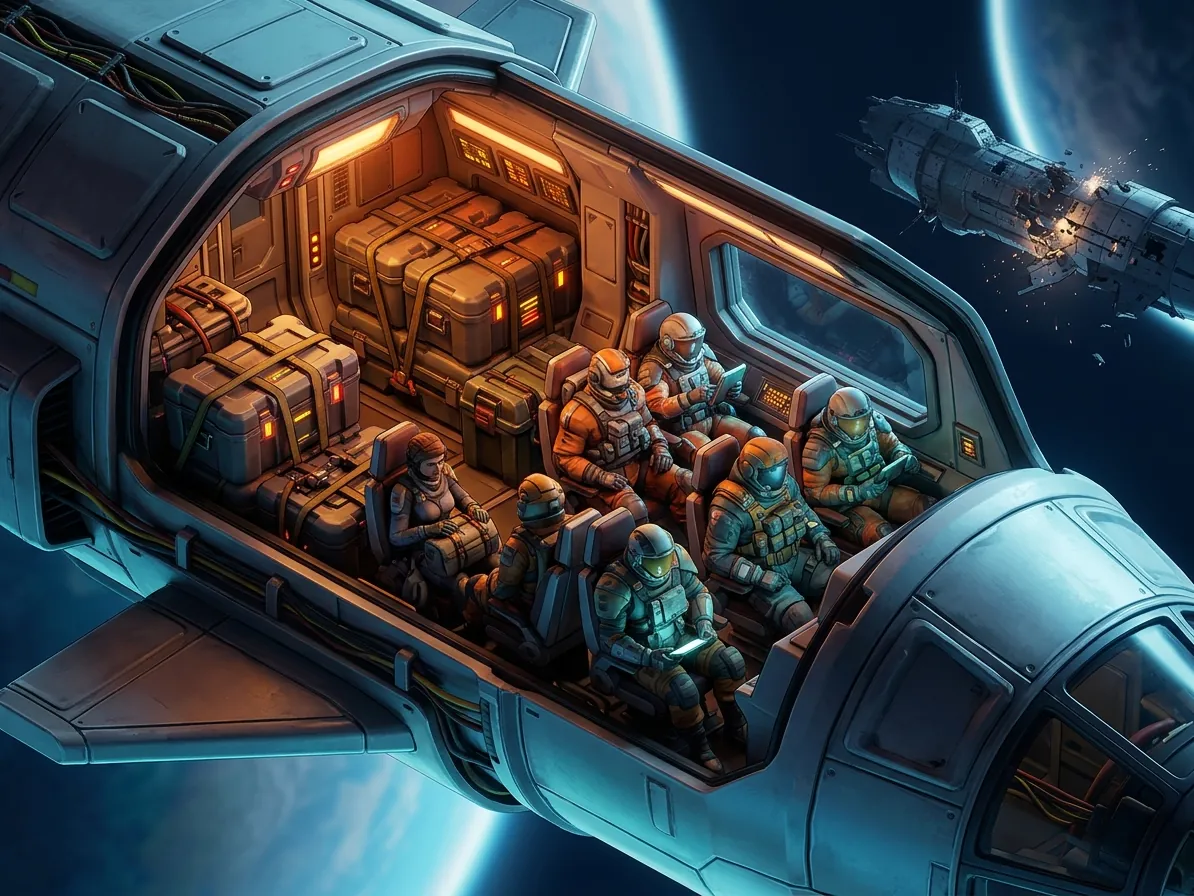
Some games give your rescue craft limited seats, life support or cargo space. When you can't take everything in one trip, you'll need to choose between making several runs or leaving something behind.
Multiple trips cost fuel and time, so check your budgets before committing. Sometimes it makes sense to move part of the crew to a safer section of the derelict first, then shuttle them over in groups. Other times, especially with a decaying orbit or failing reactor, one full trip and a fast departure is the safer play.
There isn't a universal answer, and that's the point. Capacity limits turn evacuation into a planning puzzle, and finding a plan that works for your situation is deeply satisfying.
Learning from runs that go wrong
Not every evacuation will go as planned, and that's okay. A failed run tells you a lot: which sections are more dangerous than they looked, how long the trip back really takes and where your resources ran thin.
After a tough mission, take a moment to think about the decision points. Did you spend too long exploring before finding the crew? Did you underestimate a capacity limit? Small changes in priority often make a big difference on the next attempt. If you've hit an evacuation scenario that has you stumped, tell us about it through the Contact page.
Related articles
 Why orbital rescue games deserve more attention
An opinion piece on why orbital rescue games stand out: care instead of conquest, tension without enemies and physics that quietly teaches you.
Read more
 Orbital rescue games: a beginner's overview
New to orbital rescue games? Learn what makes these missions unique, the pressures you'll face and the core skills that carry across many games.
Read more
 Matching orbits and docking with a drifting ship
A practical guide to closing in on a drifting research vessel, using the catch-up trick, docking calmly and handling a slowly tumbling target.
Read more