Matching orbits and docking with a drifting ship
Catching a research vessel in orbit takes a different kind of thinking than ordinary flying. This guide walks you through the approach, the docking and the tricky case of a tumbling target.
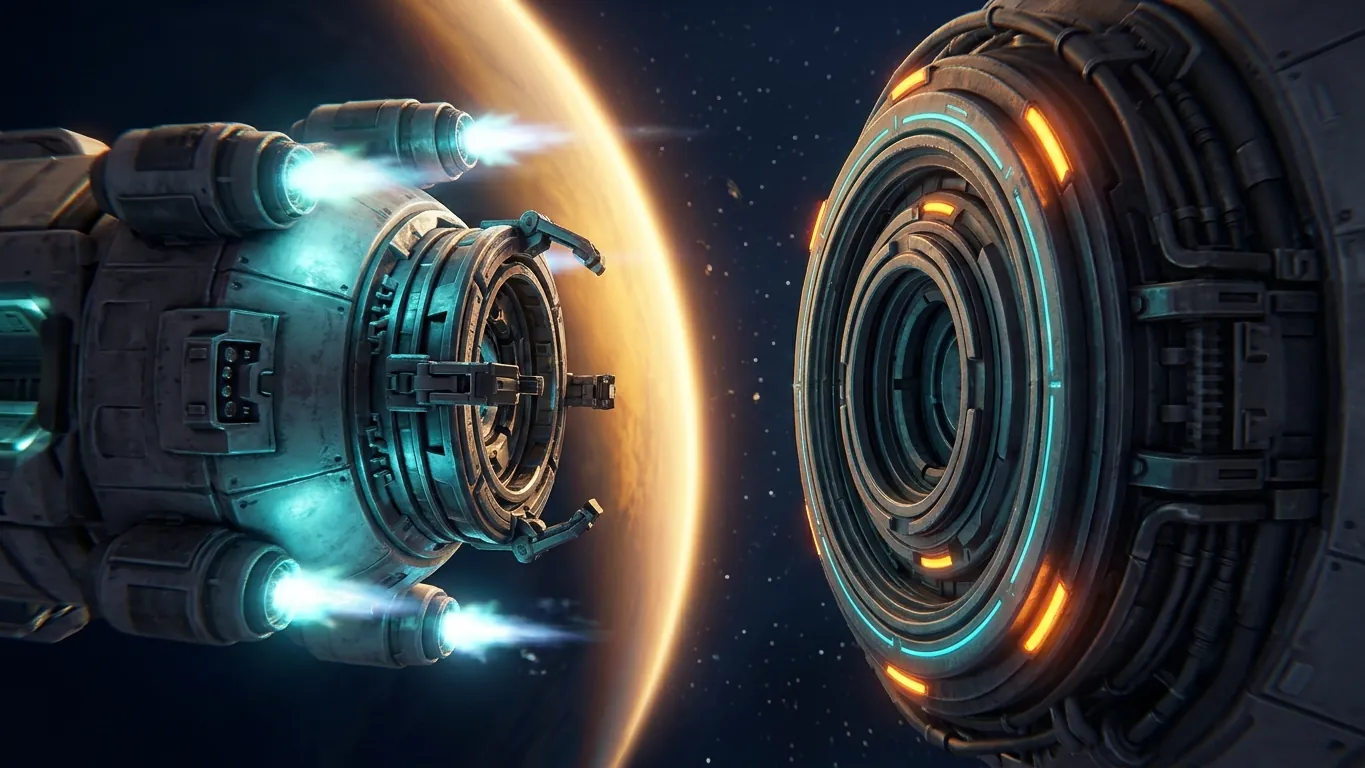
Why flying straight at the target doesn't work
In most games, if you want to reach something, you point at it and go. In orbit, that instinct often backfires. When you thrust toward a target, you change your orbit, and that changes where you'll actually be a few minutes later. Many players watch in confusion as the research ship seems to slide away, rise above them or drift behind.
The key idea is that you and the target are both falling around the planet. What matters for a rescue is not where you're pointing, but how your orbit compares to theirs. Games that model orbital physics closely make this very obvious, while more arcade-style games soften it. Either way, understanding the principle will make your approaches calmer.
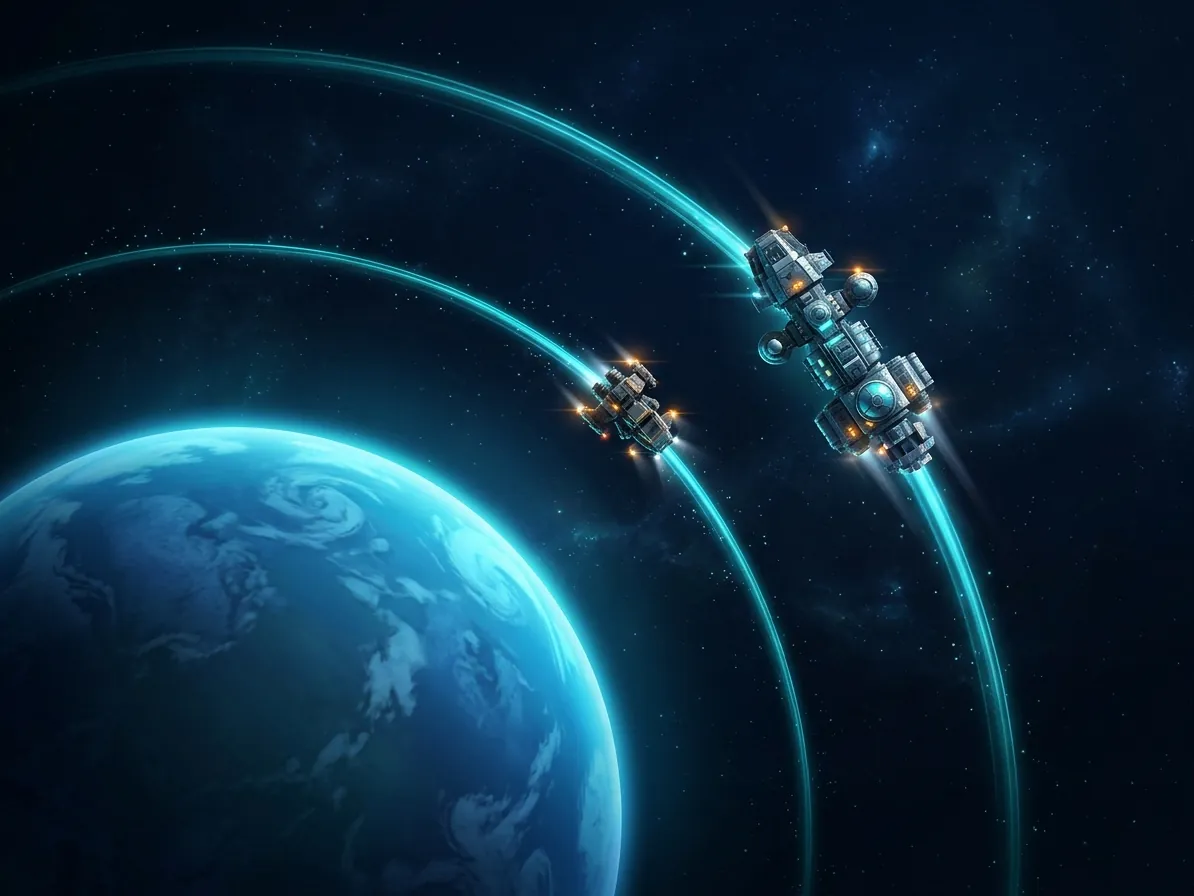
The catch-up trick: slow down to speed up
Here's the part that surprises almost everyone. In orbit, a lower orbit is faster and a higher orbit is slower. So if the research ship is ahead of you in roughly the same orbit, you usually catch up by briefly slowing down, which drops you into a lower, quicker path. Once you've gained enough ground, you burn forward to rise back up and meet the target.
The reverse also holds. If the target is behind you, a short forward burn raises your orbit and lets it gradually catch up to you.
This feels backwards for a while. A good way to practice is to make tiny burns and simply watch what happens to the predicted path, if your game shows one. Over time, the logic becomes second nature.
A calm docking approach, step by step
Once you're close, switch from orbital thinking to careful, local control.
- 01
Kill relative motion
Get your speed relative to the target as close to zero as you can before you start closing in.
- 02
Line up from a distance
Position yourself in line with the docking port while there's still plenty of room to correct.
- 03
Approach slowly
Use small forward taps and let yourself drift. A slow approach gives you time to react.
- 04
Correct sideways drift
Use small translation thrusts to stay centered rather than rotating the whole ship.
- 05
Match rotation if needed
If the port is turning, roll to match it before the final meters.
- 06
Brake before contact
Reduce your closing speed right before the collar meets the port so the connection is gentle.
Dealing with a tumbling research vessel
A powerless ship often isn't sitting still. It may be rotating slowly around one axis, or wobbling unpredictably around several. Before you get close, take a moment to watch it. Notice which axis it spins around and where the docking port ends up during each turn.
Some games let you dock on the ship's spin axis, where the motion is smallest. If the port isn't on that axis, you may need to match the rotation yourself, which takes practice and fuel. Other games give you tools like grapples or tethers to stabilize the target before docking. Whatever your game offers, resist the urge to rush in during a convenient moment. A tumbling hull can swing an antenna or solar wing straight into your path.
Common docking mistakes to avoid
Holding thrust too long is the classic one. You'll overshoot, then over-correct, then overshoot again. Short taps keep things manageable.
Another frequent mistake is focusing only on distance. You can be close and still be moving too fast sideways. Always glance at your relative velocity, not just your range.
Finally, many players forget the return trip. Docking successfully with an empty tank isn't much of a rescue. Before your final approach, check that you have enough left to undock, maneuver and head home. If you'd like a deeper look at resource planning, our fuel and oxygen article covers it in detail.
Related articles
 Fuel and oxygen budgeting for orbital rescues
Practical tips for budgeting fuel and oxygen in orbital rescue games, from keeping a return margin to knowing when to abort and try again.
Read more
 Reading a damaged research ship from the inside
An explainer on exploring derelict research ships in orbital rescue games: airlocks, pressure, power routing, research cargo and safe movement.
Read more
 Setting priorities when evacuating a stranded crew
Strategy ideas for evacuating stranded crews in orbital rescue games: early triage, a simple routine, handling capacity limits and learning from failures.
Read more