Tap, don't hold
Short thruster bursts waste less than long ones you have to cancel afterward.
Running dry halfway through a rescue is one of the most frustrating ways to fail. These tips will help you plan your propellant and air so you always have a way home.
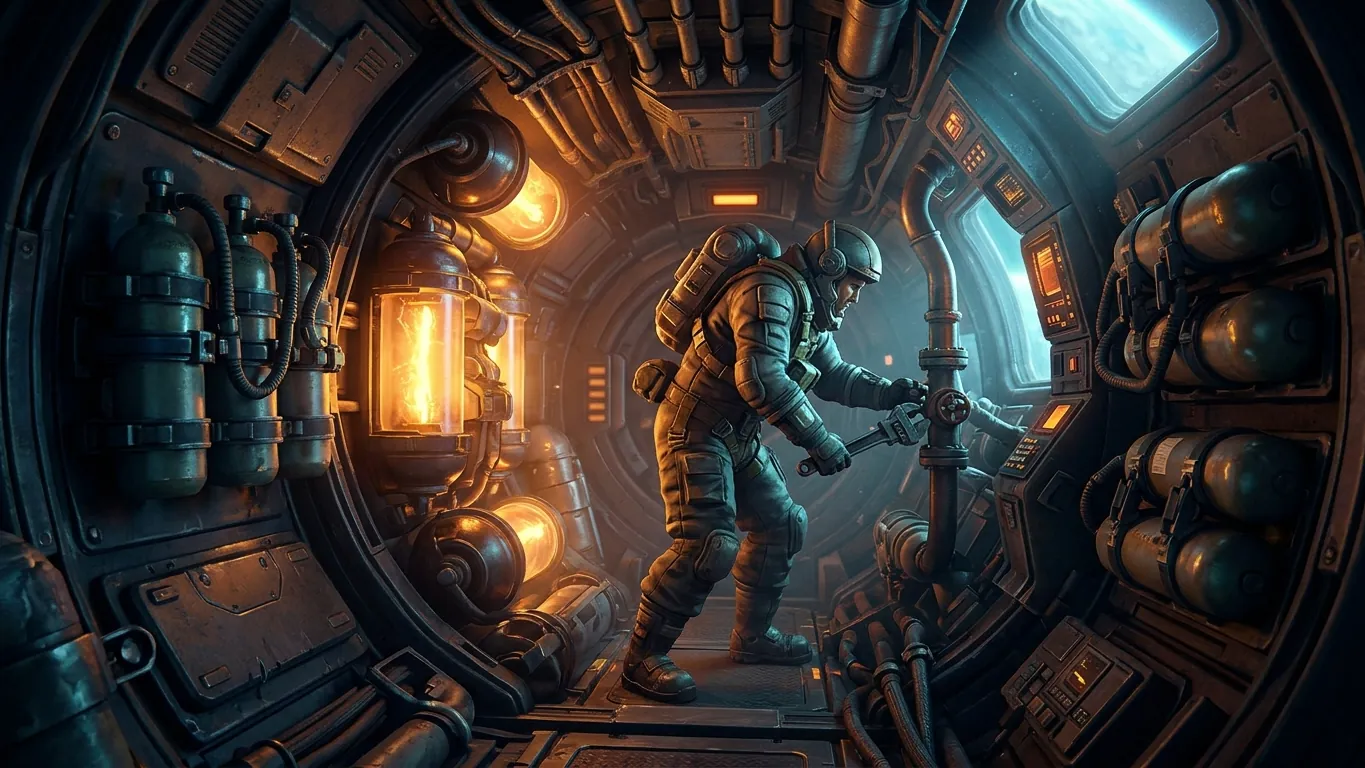
It's easy to glance at a fuel gauge and think, that's plenty. The trouble is that a full tank doesn't tell you how much of the mission it covers. A better habit is to split your resources into rough phases before you start: getting to the target, the close approach and docking, any work at the target, and the trip home.
You don't need exact numbers. Even a loose plan, like spending no more than about a third on the approach, makes you more aware of each burn. If you notice that the approach phase is eating more than you expected, you'll know early, while there's still time to adjust.
Some games show you a precise figure for how much velocity change your remaining fuel allows. If yours does, learn to read it. It's one of the most useful numbers on the screen.
The single most important rule is simple: never spend the fuel you need to get back. Decide on a reserve before you leave and treat it as untouchable. When you reach that reserve, your mission plan changes from completing the rescue to getting home safely.
A margin also protects you from surprises. Derelict research ships love to throw them at you: a sudden tumble, debris near the docking port, a crew member stuck in a far section. Each surprise costs fuel or time. With a margin in place, a surprise becomes a problem to solve instead of a mission-ending disaster.

Many orbital rescue games track breathable air separately from fuel. You may have a suit supply for spacewalks, a cabin supply for your ship and a separate supply on the stranded vessel that's slowly running out.
On spacewalks, plan your route before you leave the airlock. Wandering through a derelict looking for the right door is how suit supplies vanish. If the game gives you a map or schematic, use it.
For the stranded crew, find out early how long their air will last. That number often sets the true deadline for the whole mission. Sometimes it's worth spending extra fuel on a faster approach because the crew simply can't wait for a slow one.
None of these are dramatic, but together they add up over a mission.
Short thruster bursts waste less than long ones you have to cancel afterward.
A single well-timed burn usually costs less than several hurried corrections.
Small sideways movements often use less fuel than turning the whole craft.
Knowing where you're going inside a derelict keeps your suit air for the rescue itself.
A quick glance at each phase change helps you catch problems while they're small.
Abandoning a rescue feels bad, but sometimes it's the right call. If you've dipped into your reserve and the target is still out of reach, or if the docking keeps failing and the fuel keeps dropping, pulling back and starting over can be smarter than pushing on.
Most games let you learn from a failed attempt. Treat each abort as a scouting run. You now know how the target moves, where the obstacles are and roughly how much fuel the approach costs. Your next attempt will almost always be cleaner.
 Reading a damaged research ship from the inside
An explainer on exploring derelict research ships in orbital rescue games: airlocks, pressure, power routing, research cargo and safe movement.
Read more
 Setting priorities when evacuating a stranded crew
Strategy ideas for evacuating stranded crews in orbital rescue games: early triage, a simple routine, handling capacity limits and learning from failures.
Read more
 Why orbital rescue games deserve more attention
An opinion piece on why orbital rescue games stand out: care instead of conquest, tension without enemies and physics that quietly teaches you.
Read more